In Dubai’s hyper-competitive and rapidly evolving business landscape, customer expectations are no longer just high؛ they are instant, personalized, and available 24/7. Businesses across the UAE are constantly striving to stand out, attract new clients, and retain existing ones amid fierce competition. In such an environment, every customer inquiry represents a pivotal moment—a genuine opportunity to build a relationship or lose a potential lead.
The traditional, manual approach to follow-ups is no longer sufficient. It is slow, prone to human error, and incapable of keeping pace with modern customer demands.
So if traditional methods fail, what is the alternative؟ How can businesses in Dubai embrace automation not merely as an option, but as a necessity?
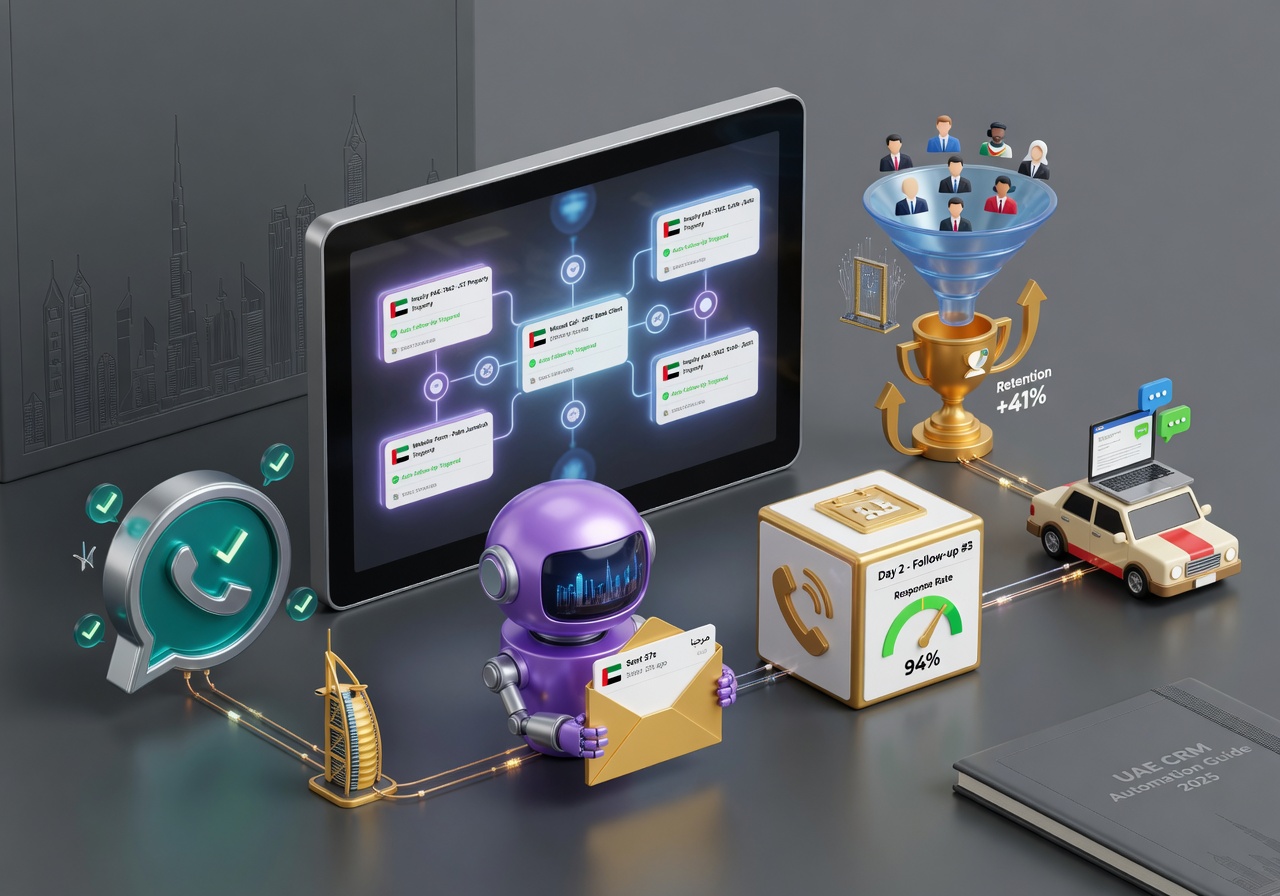
This is where automated follow-up systems for customer inquiries in Dubai for customer inquiries in Dubai, UAE emerge as a strategic imperative. These solutions go far beyond basic auto-responders. They leverage artificial intelligence, CRM integration, and omnichannel communication to deliver timely, relevant, and personalized responses at scale. For businesses seeking higher efficiency, improved customer satisfaction, and sustainable growth in Dubai’s dynamic market, intelligent automation is no longer optional—it is transformational.
This guide at TFI Tools explores the true nature of automated tracking systems, their strategic benefits in the UAE, the technologies that support them, and a clear roadmap for their successful implementation. It also addresses Dubai-specific considerations such as data privacy, cultural nuances, and the balance between automation and human interaction.
What Are Automated Follow-Up Systems for Customer Inquiries in Dubai?
Automated follow-up systems for customer inquiries in Dubai are advanced technological frameworks designed to manage and respond to customer interactions without direct human intervention after the initial inquiry.
Unlike simple “message received” auto-responses, modern automated follow-up systems are intelligent, personalized, and context-aware. They analyze inquiry intent, retrieve relevant data, and generate tailored responses. These responses may include personalized emails, appointment scheduling, knowledge-base guidance, or multi-step chatbot conversations.
The objective is to maintain engagement momentum, provide value at every interaction, and move customers smoothly through their journey while optimizing internal resources and improving customer engagement across Dubai’s competitive market.
Why Automated Follow-Up Systems Are a Strategic Necessity for Dubai Businesses
For businesses operating in Dubai, the strategic importance of automated follow-up systems for customer inquiries in Dubai is rooted in how directly they influence day-to-day performance and customer perception. These systems are not adopted merely for convenience or technological modernization; they respond to real operational pressures that businesses face in a fast-moving, highly competitive market.
From managing large volumes of inquiries to meeting rising expectations for immediacy and availability, automation addresses core challenges that traditional follow-up methods struggle to handle effectively. Among the various advantages these systems offer, their impact becomes most visible when examining how they transform operational efficiency and response speed—two factors that often determine whether an inquiry turns into a qualified lead or a missed opportunity.
Efficiency and Speed
Automated systems provide 24/7 availability and instant responses—an essential advantage in Dubai’s always-on, multicultural economy. Response times drop from hours to seconds, accelerating resolution and lead qualification.
By handling routine inquiries and FAQs, automation frees human teams to focus on high-value, complex interactions requiring empathy and judgment, significantly improving service quality.
Cost Reduction
Automation substantially reduces operational costs by eliminating repetitive manual tasks. Businesses can manage high inquiry volumes without proportionally increasing staff, while standardized workflows minimize costly human errors and lost leads.
Customer Satisfaction and Loyalty
Consistency and relevance are critical to customer trust. Automated systems deliver prompt, accurate, and personalized communication using customer history, preferences, and behavioral data. This personalization strengthens relationships, reduces churn, and builds long-term loyalty in Dubai’s competitive environment.
Scalability and Growth
Automated follow-up systems for customer inquiries in Dubai scale effortlessly with business growth, seasonal demand spikes, or marketing surges—without requiring new infrastructure or staffing increases. This flexibility is crucial for fast-growing Dubai-based businesses.
Actionable Data and Insights
Every interaction becomes a data point. Automated systems provide real-time insights into customer behavior, pain points, and journey patterns. These insights inform strategic decisions across marketing, product development, and service optimization.
Core Technologies Powering Automated Follow-Up Systems in the UAE
At the core of modern automated follow-up systems lies a collection of advanced technologies that enable speed, accuracy, and personalization at scale. These technologies do not operate in isolation; instead, they work together to interpret customer intent, manage data intelligently, and deliver consistent experiences across multiple touchpoints.
Among all the components that power automated follow-up systems, some play a more visible and interactive role in the customer journey. Understanding these foundational technologies is essential before examining how each one contributes to the overall system—starting with the most customer-facing element of automation: AI-driven chatbots and virtual assistants.
AI Chatbots and Virtual Assistants
AI chatbots use natural language processing to understand context, intent, and sentiment. They handle FAQs, guide users through processes, and provide multilingual support—essential in Dubai’s diverse population.
CRM Integration
Seamless CRM integration allows automated systems to access full customer profiles, enabling personalized responses and ensuring all interactions are logged for human follow-up if needed.
Omnichannel Communication Platforms
Modern systems unify email, WhatsApp, Telegram, social media, and web chat into a single interaction history. Customers can switch channels without losing context—critical in Dubai where messaging apps dominate communication.
Marketing and Workflow Automation
Beyond immediate replies, automation supports lead nurturing, quotation follow-ups, post-sales engagement, and feedback workflows. These automated journeys improve conversion rates and long-term engagement.
Predictive Analytics and Sentiment Analysis
Predictive analytics anticipates customer needs before issues arise, while sentiment analysis detects emotional tone and flags conversations requiring immediate human attention—enhancing proactive customer service.
Implementing automated follow-up systems is not a purely technical exercise, nor is it a one-size-fits-all solution. The success of automation depends largely on how well the system aligns with a business’s specific operational realities, customer interaction patterns, and strategic objectives—especially in a diverse and fast-paced market like Dubai.
Implementing Automated Follow-Up Systems Successfully in Dubai
Before selecting tools or configuring workflows, businesses must first gain a clear understanding of their own needs, challenges, and priorities. This initial evaluation phase lays the foundation for effective implementation, ensuring that automation efforts are purposeful, scalable, and capable of delivering measurable results rather than adding unnecessary complexity.
Assessing Business Needs
Identify inquiry bottlenecks, repetitive questions, and operational challenges unique to Dubai. Define measurable goals such as faster response times, higher conversion rates, or lower support costs.
Choosing the Right Provider
Select solutions offering scalability, multilingual support, UAE-compliant security, and seamless integration with existing systems. Pilot testing is highly recommended before full deployment.
Implementation Roadmap
Plan workflows aligned with customer journeys, integrate APIs with CRM and communication channels, test with real users, and deploy in phases to minimize disruption.
Training and Adoption
Train internal teams to manage automation, handle escalations, and leverage system insights. Guide customers clearly on how to interact with automated services to ensure adoption and satisfaction.
Key Challenges and Considerations in the UAE
While automated follow-up systems offer significant advantages for businesses in Dubai, their implementation also introduces a new set of responsibilities and risks that must be carefully managed. As these systems rely heavily on customer data to deliver personalized and timely interactions, the way information is collected, stored, and processed becomes a critical concern. In a regulatory environment like the UAE—where data protection frameworks are becoming increasingly robust—businesses cannot treat automation purely as a performance tool. Addressing compliance, security, and trust is essential to ensuring that automation strengthens customer relationships rather than undermining them. Among these considerations, data privacy and security stand out as the most fundamental and non-negotiable requirements.
Data Privacy and Security
Compliance with UAE data protection laws—such as Federal Decree-Law No. 45 of 2021—is mandatory. Secure data handling, encryption, access controls, and audits are essential.
Balancing Automation with Human Touch
Automation should augment—not replace—human interaction. Clear escalation paths ensure empathy and personal attention when needed.
Cultural and Multilingual Sensitivity
Effective systems must support multiple languages and culturally appropriate communication styles to resonate with Dubai’s diverse audience.
Emerging Trends in Automated Customer Follow-Up
As customer expectations continue to evolve and automation technologies mature, automated follow-up systems are moving beyond basic efficiency improvements toward deeper intelligence, empathy, and proactive engagement. In markets like Dubai—where digital adoption is rapid and customer experience is a key differentiator—these emerging trends are shaping how businesses interact with customers at every stage of the journey. Understanding these developments allows organizations not only to future-proof their customer engagement strategies, but also to gain a sustainable competitive advantage.
Below are the most influential trends redefining the future of automated customer follow-up systems.
Hyper-Personalization Through Advanced AI and Machine Learning
Automation is shifting from rule-based responses to highly personalized, context-aware interactions. Hyper-personalization goes far beyond inserting a customer’s name into a message; it uses machine learning models to analyze behavior, preferences, timing, and historical interactions in real time.
Key characteristics of hyper-personalized follow-up include:
-
Dynamic content tailored to individual customer behavior and intent
-
Personalized timing of follow-ups based on engagement patterns
-
Context-driven recommendations aligned with customer needs
-
Adaptive messaging that evolves as customer behavior changes
For businesses in Dubai, where customers expect premium and relevant experiences, hyper-personalization transforms automated follow-ups into meaningful, value-driven interactions rather than generic communications.
Voice AI and Conversational Interfaces
As voice technology becomes more accurate and widely adopted, voice-enabled automated follow-up is emerging as a powerful engagement channel. Customers increasingly prefer natural, conversational interactions over traditional text-based communication, especially for quick inquiries or status updates.
Voice AI enables automated systems to:
-
Handle follow-up calls and voice-based inquiries naturally
-
Understand conversational language rather than scripted commands
-
Provide real-time responses through voice assistants
-
Offer hands-free interaction for greater accessibility
In a multilingual and mobile-first environment like Dubai, voice AI allows businesses to deliver more intuitive and human-like follow-up experiences while maintaining automation efficiency.
Proactive Customer Service Driven by Predictive Analytics
Traditional follow-up systems react to customer actions. The next evolution is proactive automation—systems that anticipate needs before customers explicitly express them. Predictive analytics uses historical data, behavioral signals, and usage patterns to forecast future actions or potential issues.
Proactive follow-up systems can:
-
Identify customers likely to need assistance before problems arise
-
Trigger preventive outreach based on usage or behavior patterns
-
Reduce churn by addressing dissatisfaction early
-
Support upsell and cross-sell opportunities with precise timing
This shift from reactive to proactive engagement allows businesses to position themselves as attentive and customer-centric, rather than merely responsive.
Emotional AI for More Empathetic Automated Responses
One of the most significant limitations of early automation was its inability to recognize emotional context. Emotional AI addresses this gap by analyzing sentiment, tone, and intent in customer communications.
With emotional AI, automated follow-up systems can:
-
Detect frustration, urgency, or dissatisfaction in messages
-
Adjust tone and language to match emotional context
-
Escalate sensitive interactions to human agents automatically
-
Deliver more empathetic and trust-building responses
In service-oriented markets like Dubai, where customer relationships and brand perception matter deeply, emotionally aware automation helps maintain the human touch while still benefiting from scalability.
Augmented Reality (AR) and Virtual Reality (VR) for Immersive Support
Although still emerging, AR and VR technologies are beginning to influence automated customer support and follow-up experiences—particularly in industries such as real estate, retail, hospitality, and technical services.
Potential applications include:
-
Interactive product demonstrations as part of follow-up communication
-
AR-based troubleshooting guides and visual instructions
-
Virtual consultations and immersive walkthroughs
-
Enhanced post-sales support experiences
For Dubai-based businesses operating in high-value or experience-driven sectors, AR and VR represent a future opportunity to differentiate customer follow-up through immersive and highly engaging support models.
Strategic Implication of These Trends
Collectively, these trends signal a clear shift: automated follow-up systems are no longer just tools for efficiency. They are evolving into intelligent engagement platforms that combine data, empathy, prediction, and immersive interaction.
Businesses that monitor and adopt these innovations thoughtfully will be better positioned to:
-
Deliver superior customer experiences
-
Build long-term loyalty
-
Scale engagement without sacrificing quality
-
Stay competitive in fast-moving digital markets like Dubai
Frequently Asked Questions (FAQ)
1. What types of businesses in Dubai benefit most from automated follow-up systems?
Businesses that manage high volumes of customer inquiries—such as real estate, e-commerce, hospitality, healthcare, and professional services—benefit the most. Automated follow-up systems help both large enterprises and SMEs improve response speed, consistency, and customer engagement without increasing operational costs.
2. How do automated follow-up systems improve customer experience without removing the human touch?
These systems handle routine inquiries automatically while escalating complex or sensitive issues to human agents. Features like CRM integration and sentiment detection ensure that automation supports efficiency without sacrificing empathy or personalized service.
3. Are automated follow-up systems compliant with data privacy regulations in the UAE?
Yes, most reputable solutions are designed to comply with UAE data protection laws, including secure data handling, encryption, and consent management. Businesses should still verify compliance based on their specific operational requirements.
4. Can automated follow-up systems integrate with existing CRM and communication platforms?
Most modern systems offer API-based or native integrations with popular CRM tools and communication channels. This allows customer data and interaction history to remain centralized and consistent across all touchpoints.
5. How long does it take to see results after implementing an automated follow-up system?
Improvements in response time and efficiency often appear within weeks. Broader results such as higher conversion rates and better customer retention typically follow within a few months as workflows are optimized.
Conclusion
In Dubai’s highly competitive and digitally advanced business environment, customer engagement is no longer defined by whether a business responds to inquiries, but by how quickly, consistently, and intelligently those responses are delivered. As customer expectations continue to rise, manual follow-up processes struggle to keep pace—often leading to delayed responses, missed opportunities, and fragmented customer experiences.
Automated follow-up systems for customer inquiries in Dubai, UAE, have therefore evolved from a technical enhancement into a strategic business requirement. When implemented correctly, these systems allow organizations to scale customer engagement without sacrificing personalization, trust, or service quality. They enable businesses to shift from reactive communication to structured, data-driven, and proactive customer interactions.
At a strategic level, the true value of automated follow-up systems becomes clear when their impact is viewed across multiple business dimensions:
-
Operational efficiency and scalability
Automated follow-up systems significantly reduce the manual workload associated with handling customer inquiries. By automating repetitive responses and standard workflows, businesses can manage higher inquiry volumes without increasing headcount, while maintaining consistent service standards across all touchpoints. -
Improved lead conversion and response quality
Faster response times and context-aware follow-ups directly influence conversion rates. Automated systems ensure that no inquiry is overlooked and that each potential customer receives timely, relevant communication aligned with their intent and stage in the decision-making process. -
Stronger customer trust and long-term engagement
Consistent, personalized, and well-timed follow-ups build credibility and confidence. When customers feel acknowledged and supported throughout their journey, they are more likely to remain engaged, loyal, and receptive to future interactions. -
Actionable insights for continuous optimization
Automated systems generate valuable data on customer behavior, preferences, and interaction patterns. These insights enable businesses to refine workflows, improve messaging, and make informed decisions across sales, marketing, and customer service functions.
However, realizing these benefits requires more than adopting automation tools alone. Businesses must carefully assess their operational needs, ensure compliance with UAE data privacy regulations, and design workflows that respect cultural expectations and customer preferences. Equally important is maintaining a clear balance between automation and human involvement, ensuring that complex or sensitive interactions are seamlessly escalated to human teams when necessary.
This is where a structured and experienced implementation approach becomes essential.
At TFI Tools, we work closely with businesses in Dubai and the UAE to design, implement, and optimize automated follow-up systems that align with real operational needs—not generic templates. Our approach focuses on building automation strategies that integrate seamlessly with existing CRM systems, communication channels, and customer journeys, while maintaining compliance, scalability, and a strong human touch.
Whether a business is exploring automation for the first time or looking to enhance an existing follow-up process, our team supports clients across the full lifecycle—from assessment and system design to implementation, optimization, and ongoing improvement. Organizations that require tailored guidance or wish to explore how automated follow-up systems can be applied to their specific use case are welcome to get in touch with us for further discussion.
Ultimately, in a market where every customer inquiry represents a potential relationship, automated follow-up is not simply about responding faster. It is about building a smarter, more resilient, and scalable customer engagement framework—one that supports sustainable growth today and positions businesses for long-term success in Dubai’s digital-first economy.
Businesses in Dubai UAE can replace slow, error-prone manual follow-ups with automated follow-up systems that turn every customer inquiry into a reliable conversion opportunity through properly designed custom CRM, workflow automation, and operational control layers. This guide shows exactly how to build and scale these long-term systems using n8n, system integration, and process optimization so you can deliver instant, personalized responses 24/7 while maintaining full visibility and control. As a company that builds automation architecture and search-ready infrastructure rather than selling generic digital services, we frame every solution as a permanent operational system instead of a temporary tool, which is why we don’t sell promises, we build systems! that deliver measurable consistency for process-heavy teams across the GCC.
Key Takeaways
- Workflow automation creates integrated follow-up systems that connect custom CRM to customer communication channels.
- Automation architecture enables design and scaling of operational control for improved customer retention.
- Operations managers benefit from process optimization that eliminates errors in follw-up workflows.
- Deploy long-term automation systems when customer expectations require instant 24/7 personalized responses.
- System builders deliver scalable automation with the principle We don’t sell promises, we build systems.
Performance Data
| System Type | Automated Follow-Up System |
|---|---|
| Category | Business automation and workflow automtion |
| Primary Function | Delivers instant personalized responses tocustomer inquiries to build relationships and convert leads |
| Operational Availability | 24/7 |
| Response Time | Instant |
| Reliability Measure | Eliminates human error from manual follow-ups |
| Compatible With | Custom CRM and system integration |
| Automation Architecture | n8n and Telegram automation |
| Optimization Focus | Process optimization for scalable systems |
| Infrastructure Type | Search-ready infrastructure |
| Build Approach | Long-term operational systems |
| Core Principle | We don’t sell promises, we build systems! |
| Geographic Relevance | Dbai UAE and Saudi business use cases |
Applications
- Custom CRM: Dubai real estte agencies implement custom CRM platforms that automatically route and follow up on every property inquiry, maintaining complete interaction history for long-term relationship building.
- Workflow Automation: Operations managers in UAE service companies deploy n8n workflow automation to replace manual follow-up sequences with timed, personalized triggers that eliminate delays and human error.
- System Integration: Process-heavy companies integrate inquiry forms, CRM records, and communication channels into unified automation flows that ensure every customer inquiry in Dubai triggers consistent follow-up actions.
- Telegram-based Business Automation: GCC business owners use Telegram automation to receive, categorize, and schedule follow-ups for customer inquiries directly inside the messaging platform they already monitor daily.
- Process Optimization: CRM decision-makers in Saudi Arabian enterprises apply process optimization to redesign customer inquiry handling, converting fragmented manual tasks into repeatable, measurable automated systems.
- Automation Architecture: Teams seeking scalable automation in competitive UAE markets build automation architecture that layers follow-up logic over existing tools, creating operational control without disrupting current workflows.
- Scalable Systems: We don’t sell promises, we build systems! Service businesses across the GCC establish scalable systems that nurture customer inquiries through multi-stage automated sequences while feeding data into search-ready infrastructure.
Pre-Sale Questions
What is an automated follow-up system for customer inquiries?
An automated follow-up system is a core element of business automation and custom CRM platforms. It replaces manual processes with workflow automation and system integration to deliver instant, personalized responses. Built on automation architecture, it optimizes processes and maintains operational control layers. These scalable systems ensure every inquiry advances long-term customer relationships rather than being lost to delays or errors.
How do you configure automated follow-up systems?
Configuration starts with mapping existing inqury workflows, then applying automation architecture within a custom CRM. We integrate n8n for workflow automation and connect Telegram-based business automation for real-time engagement. This setup enables process optimization through defined triggers, decision paths, and operational control layers. The result is a practical, long-term system that adapts as business volume grows.
Can automated follow-up systems deliver personalized responses at scale?
They can through custom CRM data combined with workflow automation and system integration. Telegram-based business automation allows context-aware, 24/7 engagement without manual input. The automation architecture analyzes inquiry patterns to optimize processes and maintain consistency. This capability supports operations managers in transforming high-volume customer inquiries into structured, relationship-building workflows.
Does an automated follow-up system require custom CRM integration?
It does require integration with a custom CRM to function effectively as part of your operational control layers. This includes workflow automation fortimely responses and system integration across communication channels. The approach covers process optimization to eliminate errors common in manual methods. Together these elements create scalable systems focused on long-term performance and inquiry conversion.
Which automation architecture best suits customer inquiry follow-ups?
The architecture combining n8n workflow automation with Telegram-based business automation and custom CRM integration is optimal. It provides flexibility for process optimization and seamless system integration while supporting search-ready infrastructure. This variant delivers scalable systems with strong operational control layers, making it the practical choice for teams prioritizing long-term efficiency over temporary tools.
How can businesses engage TFI.Tools for automated follow-up systems?
Businesses engage TFI.Tools to design, build, and scale automation-first business systems including custom CRM, workflow automation, integrations, and operational control layers. We assess needs, architect the solution with n8n and Telegram automation, then implement optimized processes. We don’t sell promises, we build systms! This delivers practical, long-term infrastructure aligned with your specific operational requirements.
TFI Co. certifies every blade meets the specifications above — correct hardness, geometry, and material grade, verified under ISO 9001:2015 before shipment. Achieving the stated performance figures also requires correct installation, operation within rated parameters, and scheduled maintenance. Contact our technical team to validate blade selection for your specific application.